


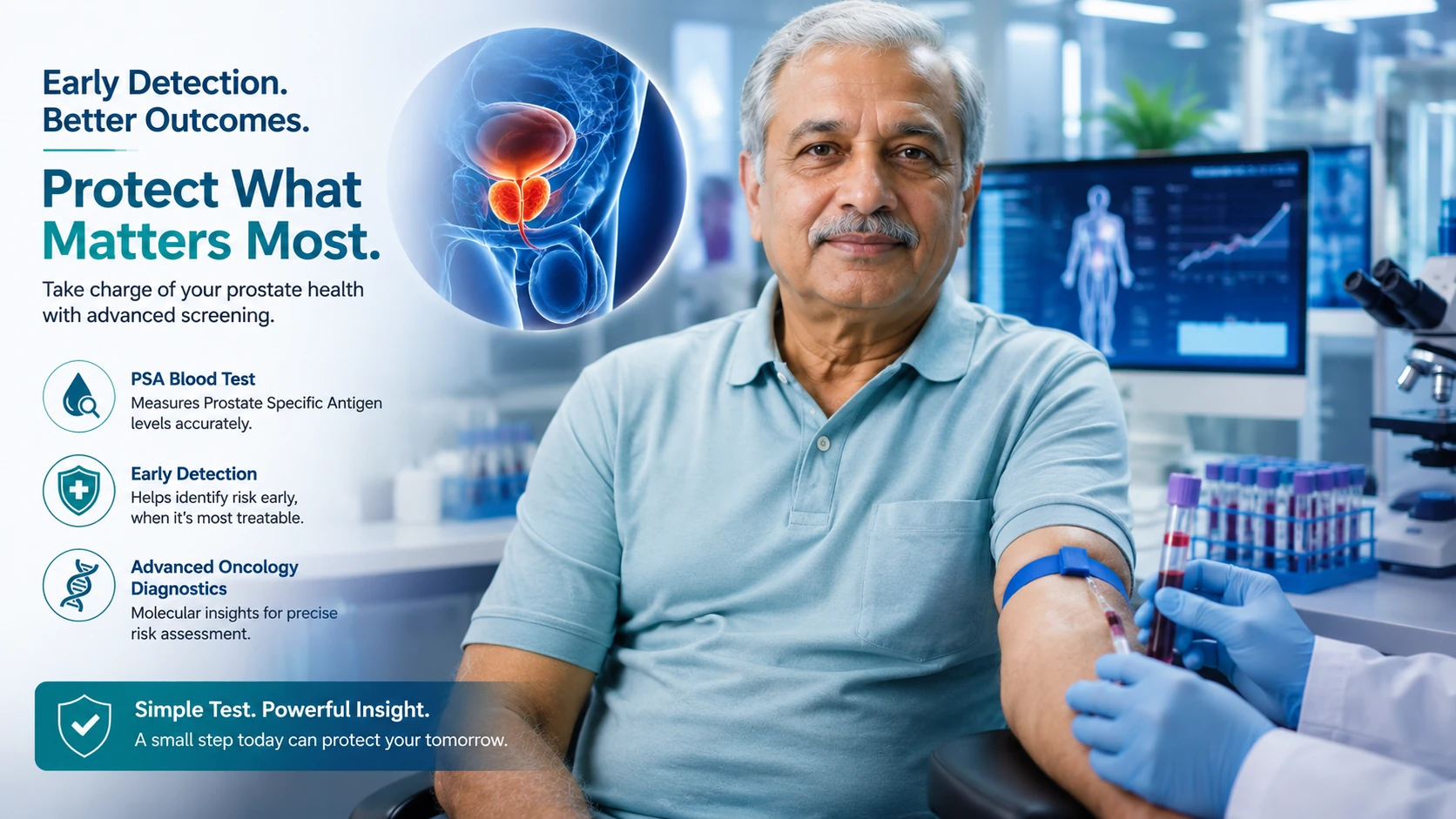
50+ Men: Know Your PSA — Why Early Prostate Cancer Detection Matters
PSA Test at a Glance
- Sample Required: Blood sample (serum)
- Fasting Rules: No fasting required
- Turnaround Time (TAT): 24–48 hours
- Base Cost: [Insert Current 2026 Price]
For many men, turning 50 changes the way preventive health should be approached. Blood pressure, blood sugar, cholesterol, and heart health often receive attention—but prostate health deserves a place in the conversation too.
One test frequently discussed in this context is PSA, or prostate-specific antigen. PSA is a protein produced by prostate cells and can be measured through a blood test. A higher PSA level can be associated with prostate cancer, but it can also occur with non-cancerous conditions such as benign prostate enlargement or prostatitis. That is why PSA should be viewed as a risk signal, not a cancer verdict.
Age as a Primary Risk Factor for Prostate Cancer
Age is one of the strongest risk factors for prostate cancer. Prostate cancer is uncommon in younger men, while its incidence increases substantially with advancing age. The National Cancer Institute reports that prostate cancer is rarely seen before age 40 and that incidence rises rapidly with each subsequent decade.
The U.S. Preventive Services Task Force recommends that men aged 55–69 make an individual decision about periodic PSA-based screening after discussing its potential benefits and harms with a clinician; it recommends against PSA-based screening in men aged 70 and older. Other professional guidelines use somewhat different age thresholds and risk-based approaches.
PSA and Prostate Symptoms: Don't Wait for Symptoms Alone
Another misconception is that prostate-cancer testing is only necessary when urinary symptoms appear. Early prostate cancer may produce no noticeable symptoms. Urinary symptoms such as increased frequency, difficulty starting urination, or a weak urine stream can occur with prostate conditions, but they do not automatically mean cancer. Likewise, the absence of urinary symptoms does not rule out prostate cancer.
That is why risk assessment and early-detection discussions can be relevant even for men who feel completely well.
Symptoms That Deserve Medical Evaluation
Men should speak with a qualified healthcare professional if they experience symptoms such as:
- Blood in the urine or semen
- Persistent difficulty urinating
- A weak or interrupted urine stream
- Frequent or troublesome urination, particularly at night
- Pelvic, back, or other persistent pain
These symptoms have several possible causes and are not specific to prostate cancer, but they should not be ignored.
Does Lifestyle Prevent Prostate Cancer?
There is no proven diet, supplement, or lifestyle programme that can guarantee prevention of prostate cancer. Research has examined factors including body weight, physical activity, diet, smoking, and various nutritional supplements, but evidence for specific dietary or supplement strategies remains mixed. The National Cancer Institute notes that some commonly promoted supplements, including vitamin E and selenium, have not been proven to prevent prostate cancer.
That does not make healthy living irrelevant. Regular physical activity, maintaining a healthy weight, avoiding tobacco, and following a balanced diet remain sensible for overall health and may reduce the risk of several chronic diseases. But they should complement—not replace—appropriate medical risk assessment.
What Should a Man in His 50s Actually Do?
A sensible prostate-health conversation can start with five questions:
- What is my personal risk based on my age and family history?
- Have I ever had a baseline PSA measurement?
- Could any medication, infection, prostate condition, or recent activity affect my PSA?
- If my PSA is elevated, what should the next step be?
- Would additional testing help distinguish a benign PSA elevation from a higher-risk finding?
Understanding PSA Levels
PSA levels are measured in nanograms per milliliter (ng/mL). While there is no universal cutoff, the following table provides a general interpretation:
| PSA Level (ng/mL) | Interpretation |
|---|---|
| < 2.5 | Low risk; consider retesting based on clinical judgment. |
| 2.5 – 4.0 | Borderline; may require further evaluation or repeat testing. |
| 4.0 – 10.0 | Elevated; further evaluation (e.g., repeat PSA, additional biomarkers, imaging) is typically recommended. |
| > 10.0 | High; prompt urological consultation and likely biopsy are advised. |
Note: PSA levels can be influenced by factors such as recent ejaculation, urinary tract infection, or certain medications. Always interpret results with a healthcare provider.
Next Steps After an Elevated PSA
If your PSA is elevated, your doctor may recommend one or more of the following:
- Repeat PSA testing to confirm the result
- Digital rectal exam (DRE) to assess the prostate
- Additional biomarkers (e.g., free PSA, PCA3) or imaging (e.g., MRI)
- Prostate biopsy if clinically indicated
The next step should be individualized based on your overall health, life expectancy, and personal preferences.
Frequently Asked Questions
Is a high PSA always prostate cancer?
No. PSA can increase because of prostate cancer, but also because of benign prostate enlargement, prostatitis, and other factors. A raised PSA requires clinical interpretation rather than being treated as a cancer diagnosis.
Can prostate cancer exist without symptoms?
Yes. Early prostate cancer may cause no noticeable symptoms, which is one reason early-detection discussions can be important for appropriately selected men.
What happens if PSA is elevated?
Depending on the PSA level and clinical circumstances, a doctor may recommend repeating the PSA, performing further clinical assessment, using additional biomarkers or imaging, or considering biopsy. The next step should be individualized.
Can lifestyle changes replace PSA testing?
No. Healthy lifestyle choices are important for overall health, but there is no proven lifestyle programme that eliminates prostate-cancer risk. Appropriate screening or diagnostic decisions should be based on individual risk and clinical advice.
Prostate Cancer Screening at DNA Labs India
DNA Labs India offers the OncoPro Prostate Cancer Screen Test as part of our preventive wellness portfolio. As an ISO 9001 certified lab, we ensure accurate and reliable results with a quick turnaround time.
Written by: Dr. [Author Name]
Medically Reviewed by: Dr. [Reviewer Name]
Last Updated: [Month Day, 2026]