
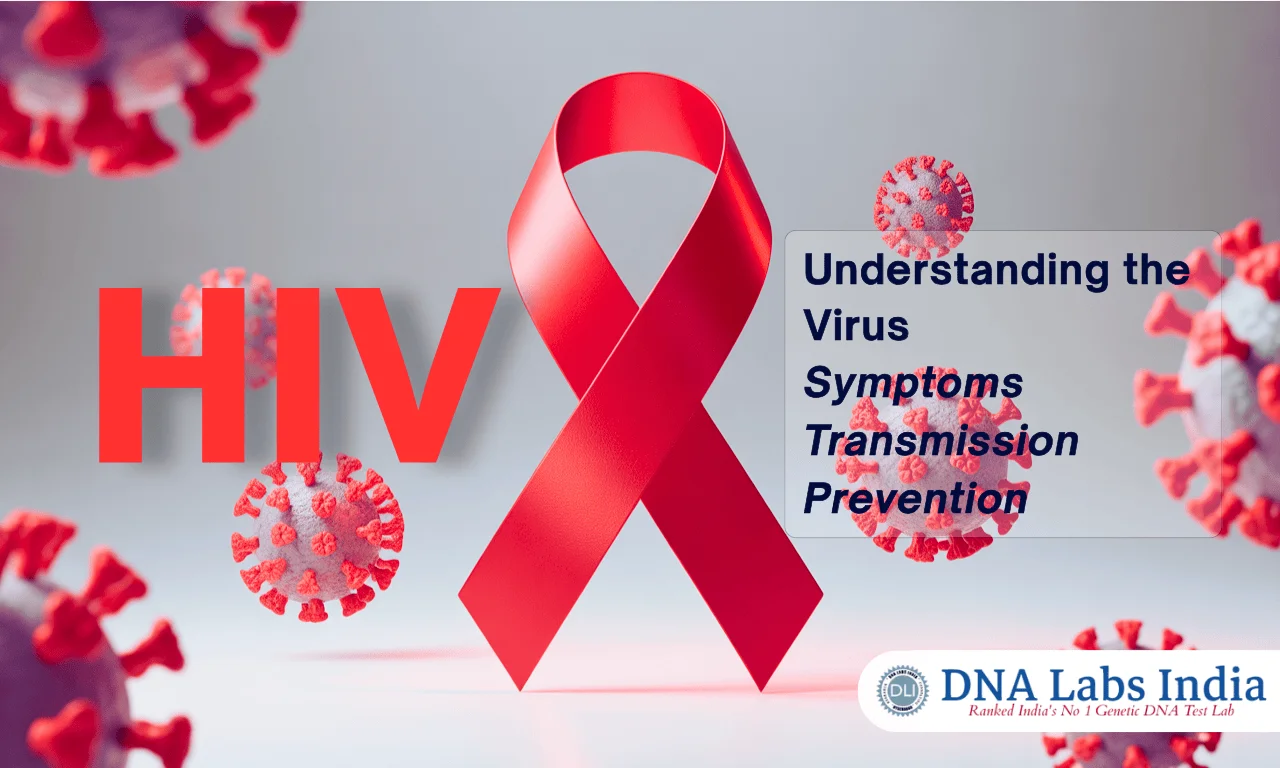
HIV: Comprehensive Guide to Symptoms, Transmission, Testing, and Prevention
At a Glance
- Sample Required: Blood (serum/plasma)
- Fasting Rules: Not required
- Turnaround Time (TAT): 1–3 days (varies by test)
- Base Cost: [Insert Current 2026 Price]
Introduction: What is HIV?
HIV (Human Immunodeficiency Virus) is a retrovirus that attacks the immune system, specifically CD4 T-cells, which are crucial for fighting infections. If left untreated, HIV can progress to AIDS (Acquired Immunodeficiency Syndrome), the most advanced stage of infection. Early detection and treatment are vital for managing the virus and preventing transmission.
At DNA Labs India, an ISO 9001 certified lab, we provide accurate and early HIV testing, including HIV RNA PCR and 4th generation antigen/antibody tests, to ensure timely diagnosis and effective treatment.
HIV-1 vs HIV-2: Types of HIV
HIV has two main types: HIV-1 and HIV-2. Both cause similar clinical syndromes, but they differ in origin, prevalence, and progression.
HIV-1
- Most common type globally (~95% of infections).
- Origin: Derived from a chimpanzee virus (SIVcpz) in Central Africa.
- Subtypes/Groups: Multiple subtypes (M, N, O, P); Group M caused the global pandemic.
- Transmission: Same as general HIV (sex, blood, mother-to-child, contaminated needles).
- Progression: Faster progression to AIDS if untreated.
- Geography: Worldwide.
HIV-2
- Less common, mostly in West Africa.
- Origin: Derived from SIVsmm virus in sooty mangabey monkeys.
- Transmission: Same routes, but less easily transmitted sexually.
- Progression: Slower progression to AIDS; many remain asymptomatic for years.
- Geography: Primarily West Africa, rare globally.
Key Differences
| Feature | HIV-1 | HIV-2 |
|---|---|---|
| Prevalence | Worldwide (~95%) | West Africa (less common) |
| Transmission | More efficient | Less efficient |
| Disease Progression | Faster | Slower |
| Subtypes | Multiple (M, N, O, P) | Few (A–H) |
| Global Impact | Pandemic | Localized |
HIV Symptoms: Early and Late Signs
HIV symptoms vary by stage. Early detection is critical. Below is a timeline of symptom progression.
| Stage | Timeframe | Common Symptoms |
|---|---|---|
| Acute HIV Infection | 2–4 weeks post-exposure | Fever, fatigue, sore throat, swollen lymph nodes, rash |
| Chronic HIV Infection | Years (latent) | Often asymptomatic; virus continues to damage immune system |
| AIDS (Advanced HIV) | Untreated, typically 8–10 years | Rapid weight loss, recurrent infections, persistent fever, night sweats, chronic diarrhea, neurological issues |
Transmission Vectors and Incubation
HIV is transmitted through specific body fluids: blood, semen, vaginal fluids, rectal fluids, and breast milk. The virus enters the body through mucosal surfaces, damaged tissue, or direct blood contact.
Common Transmission Routes
- Unprotected sexual contact (vaginal, anal, oral)
- Sharing needles or syringes
- Mother-to-child (pregnancy, birth, breastfeeding)
- Rarely, contaminated blood products (now screened)
Myth-Busting
HIV cannot spread through casual contact, food, saliva, sweat, or insect bites. The virus is fragile and does not survive long outside the body.
HIV Testing: Early Detection and Diagnosis
Early HIV testing is critical for treatment and prevention. DNA Labs India offers a range of tests to suit different needs. Below is a comparison of available tests.
| Test Type | What It Detects | Window Period | Best Use |
|---|---|---|---|
| Antibody Test | HIV antibodies (IgG/IgM) | 3–12 weeks | Routine screening |
| 4th Generation Antigen/Antibody | p24 antigen + antibodies | 2–4 weeks | Early detection |
| HIV RNA PCR Qualitative | HIV RNA (genetic material) | 10–33 days | High-risk exposure, newborns |
| HIV RNA Quantitative (Viral Load) | Amount of HIV RNA | 10–33 days | Monitoring treatment |
All tests are performed using advanced molecular diagnostics, including RT-PCR, ensuring high sensitivity and specificity.
HIV Treatment: Antiretroviral Therapy (ART)
While there is no cure, ART can effectively manage HIV. Treatment goals include:
- Suppress viral replication
- Restore immune function
- Prevent progression to AIDS
- Reduce viral load to undetectable, making sexual transmission virtually zero (U = U)
Treatment is most effective when started early. Adherence to ART is crucial for long-term health.
Preventing HIV: How to Stay Safe
Practical Prevention Tips
- Consistently use condoms
- Consider PrEP (pre-exposure prophylaxis) for high-risk individuals
- Use PEP (post-exposure prophylaxis) within 72 hours after exposure
- Avoid sharing needles
- Get regular HIV testing
Food, Animals, and Casual Contact
- HIV cannot spread through food, water, or animal contact.
- Blood on surfaces or food does not cause infection.
HIV Myths vs Facts
| Myth | Fact |
|---|---|
| HIV spreads through saliva or sweat | FALSE – HIV cannot survive in saliva or sweat |
| HIV can be caught from sharing food | FALSE – HIV is not transmitted via food |
| Only certain people can get HIV | FALSE – anyone exposed can be infected |
Conclusion
At DNA Labs India, we provide comprehensive HIV testing, including HIV-1 and HIV-2 detection, HIV RNA PCR tests, and viral load monitoring. Early detection, safe practices, and effective treatment empower individuals to live long, healthy lives while reducing transmission risk.