
At a Glance: Large Intestine Health
- Sample Required: Stool sample for routine screening; blood sample for genetic risk assessment.
- Fasting Rules: No fasting required for stool or genetic tests; colonoscopy requires bowel prep.
- Turnaround Time (TAT): Stool tests: 24-48 hours; genetic tests: 7-14 days.
- Base Cost: [Insert Current 2026 Price] – varies by test; contact DNA Labs India for exact pricing.
Large Intestine: Structure, Functions, and Key Facts
The large intestine is the last section of the human digestive tract. It starts where the small intestine ends and is made up of four main parts: the cecum, colon, rectum, and anus. Shaped like a loop around the small intestine, the large intestine is about 1.5 meters (5 to 6 feet) long and wider than the small intestine.
Anatomy of the Large Intestine
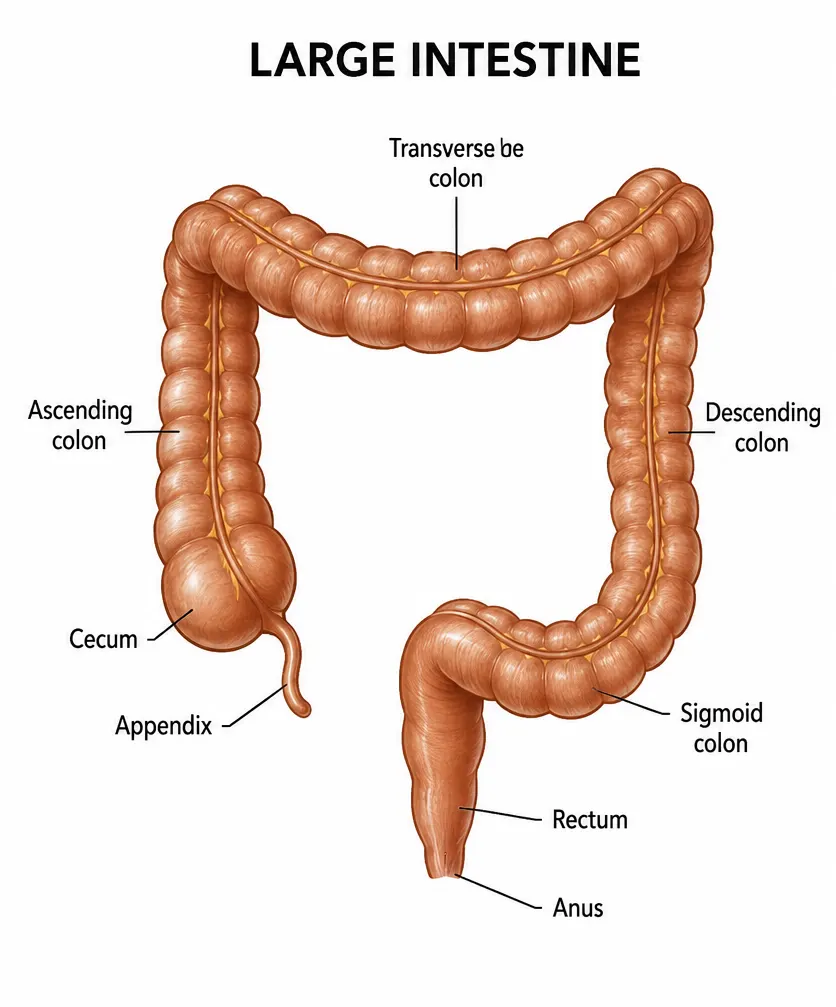
The large intestine is the final part of your digestive tract, responsible for managing waste before it exits your body. It consists of several key sections:
- Cecum
- Colon (with sections: ascending, transverse, descending, sigmoid)
- Rectum
- Anus
The main job of the large intestine is threefold: it absorbs water and salts from what remains after your small intestine has done its work; it crafts this material into stool; and finally, it moves waste out of your body efficiently.
| Part | Location/Feature | Function |
|---|---|---|
| Cecum | Lower right abdomen | Receives waste from small intestine |
| Ascending Colon | Right side of abdomen | Absorbs water and electrolytes |
| Transverse Colon | Across the abdomen | Moves waste horizontally |
| Descending Colon | Left side of abdomen | Stores waste, absorbs more water |
| Sigmoid Colon | S-shaped section (lower left) | Prepares stool for elimination |
| Rectum & Anus | End of the digestive tract | Stores stool and expels it during bowel movements |
Physiological Functions
- Absorbs water and electrolytes: Converts liquid waste into solid stool by removing excess water.
- Forms and stores stool: Compacts waste and holds it until it can be eliminated from the body.
- Supports gut bacteria: Houses beneficial microbes that aid in digestion and help produce certain vitamins (like vitamin K and B group).
- Eliminates waste: Propels stool out of the body during a bowel movement.
Common Pathologies of the Large Intestine
Disorders affecting the large intestine are widespread. Some of the most common include:
- Chronic constipation and diarrhea
- Hemorrhoids
- Irritable Bowel Syndrome (IBS)
- Inflammatory Bowel Disease (IBD)
- Colon polyps
- Colorectal cancer
Warning Signs and When to Seek Medical Attention
Promptly seek professional advice if you notice:
- New or persistent changes in how often or how easily you pass stool
- Blood visible in your stool
- Ongoing abdominal cramps or bloating
- Fatigue that doesn’t have an obvious cause
- Unintentional weight loss or persistent tiredness
Addressing symptoms early can lead to much better outcomes, especially for conditions like colorectal cancer.
Screening vs. Diagnostic Tests for Colon Health
Understanding the difference between screening and diagnostic tests is crucial for early detection and prevention.
| Aspect | Screening Tests | Diagnostic Tests |
|---|---|---|
| Purpose | Detect early signs in asymptomatic individuals | Confirm or rule out a suspected condition |
| Examples | Fecal occult blood test (FOBT), stool DNA test, colonoscopy (preventive) | Colonoscopy with biopsy, CT colonography, genetic testing for hereditary syndromes |
| Frequency | Every 1-10 years depending on risk | As needed based on symptoms or screening results |
Preventive Strategies for a Healthy Colon
You can help your colon function at its best by following these simple steps:
- Eat plenty of fiber: Fresh fruits, vegetables, and whole grains are key.
- Drink enough fluids: Proper hydration supports digestion and regularity.
- Cut back on processed and red meats: These are linked to a greater risk of colon problems.
- Avoid tobacco and limit alcohol intake
- Maintain regular activity: Exercise supports natural digestive movement.
- Schedule routine screenings: Colonoscopies can catch polyps and early cancer, especially vital for individuals with a family history or genetic risk.
Genetic Testing and Colon Health
Genetic factors play a significant role in colorectal cancer risk. At DNA Labs India, we offer advanced genetic testing using Next-Generation Sequencing (NGS) and Whole Exome Sequencing (WES) to identify hereditary syndromes such as Lynch syndrome and Familial Adenomatous Polyposis (FAP). Early identification allows for proactive surveillance and preventive measures.
Our ISO 9001 certified lab ensures accurate and reliable results. For personalized assessments or more information on genetic testing for colon health, contact DNA Labs India today.
Conclusion
A healthy large intestine is essential for your well-being. By making smart lifestyle decisions, getting regular checkups, and understanding your genetic risks, you can protect yourself and your family. At DNA Labs India, we’re here to support your preventive health strategy.
Written by: DNA Labs India Content Team
Medically Reviewed by: Dr. [Name], Medical Geneticist
Last Updated: [Insert Date]