

Migraine Decoded: Types, Causes, Treatment Advances, and the Genetic Story Behind the Pain
Key Facts at a Glance
- Sample Required: Blood or saliva for genetic testing
- Fasting Rules: No fasting required
- Turnaround Time (TAT): 2-3 weeks
- Base Cost: [Insert Current 2026 Price]
Written by: Dr. [Name] | Medically Reviewed by: Dr. [Name] | Last Updated: [Date]
Migraine is not "just a bad headache." It is a complex neurovascular disorder with distinct subtypes, well-mapped genetic risk factors, and—over the last decade—some of the most significant treatment breakthroughs in neurology. This piece covers the clinical classification of migraine, what's happening at the molecular level, current treatment and lifestyle management, the latest advancements in therapy, and what genetic research is now revealing about who gets migraine and why.
1. Pathophysiology of Migraine: The Trigeminovascular Cascade
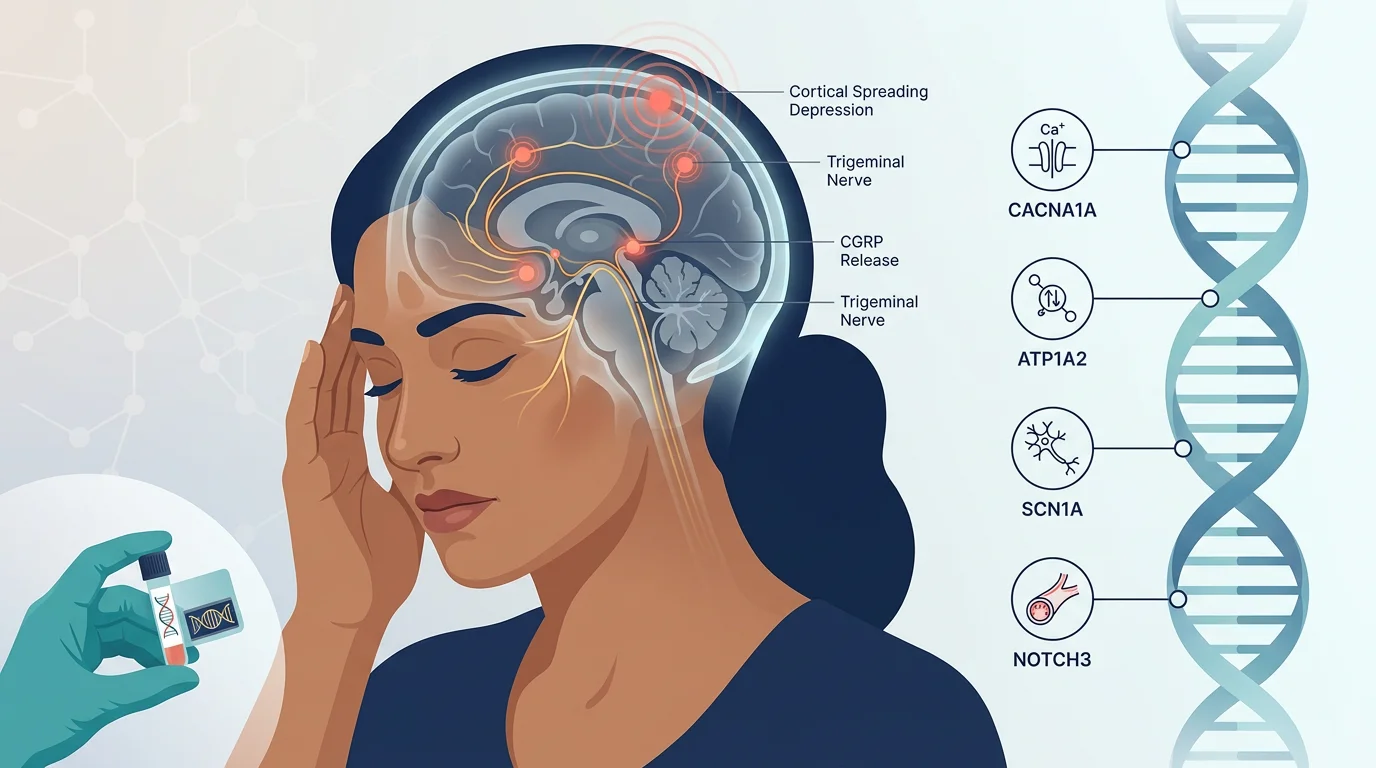
Migraine is currently understood as a disorder of the trigeminovascular system—the network connecting the trigeminal nerve to the blood vessels of the meninges (the membranes covering the brain). An attack unfolds as a cascade:
- Cortical spreading depression (CSD): A wave of neuronal and glial depolarization moves across the cortex, thought to underlie the aura phase in some patients.
- Trigeminal activation: Sensory neurons release neuropeptides—most importantly calcitonin gene-related peptide (CGRP)—that trigger inflammation and dilation of blood vessels in the meninges.
- Central sensitization: Pain-processing neurons in the brainstem and thalamus become hypersensitive, which is why light, sound, and even scalp touch become unbearable during an attack.
This CGRP-centered model is the single biggest reason migraine treatment has been transformed in the last ten years.
2. Clinical Classification of Migraine Subtypes
Migraine is not one disease—it's a spectrum of related disorders classified by the International Classification of Headache Disorders (ICHD-3).
Migraine Without Aura
The most common form (roughly 70-75% of cases). Recurrent attacks of moderate-to-severe, usually one-sided, pulsating pain lasting 4-72 hours, accompanied by nausea and sensitivity to light/sound.
Migraine With Aura
Around 25-30% of patients experience transient neurological symptoms before or during the headache—visual disturbances (zigzag lines, flashing lights, blind spots), sensory symptoms (tingling, numbness), or speech disturbances, typically lasting 5-60 minutes.
Hemiplegic Migraine (Familial and Sporadic)
A rare but clinically important subtype where aura includes temporary motor weakness on one side of the body—a feature that sets it apart from every other migraine type. This is also the most genetically well-defined form of migraine: three genes account for most identified familial hemiplegic migraine (FHM) cases, each corresponding to a distinct FHM subtype:
- CACNA1A — Familial Hemiplegic Migraine Type 1 (FHM1)
- ATP1A2 — Familial Hemiplegic Migraine Type 2 (FHM2)
- SCN1A — Familial Hemiplegic Migraine Type 3 (FHM3)
Because a hemiplegic migraine attack can closely mimic a stroke or transient ischemic attack (TIA), correctly identifying it—clinically and, where indicated, genetically—has real consequences for how urgently and how a patient is managed.
Chronic Migraine
Defined as headache on 15 or more days per month for at least three months, with migrainous features on at least 8 of those days. Chronic migraine carries a heavier disease burden and often needs a fundamentally different treatment strategy (preventive therapy, onabotulinumtoxinA, or CGRP-targeted prevention) than episodic migraine.
Vestibular Migraine
Recurrent episodes of vertigo or dizziness associated with migraine features, often under-recognized because patients present to ENT or neurology separately.
Menstrual Migraine
Triggered by the drop in estrogen just before menstruation; often more severe, longer, and less responsive to standard acute treatment than migraine at other points in the cycle.
Migraine With Brainstem Aura, Retinal Migraine, and Status Migrainosus
Rarer variants—brainstem aura involves symptoms like vertigo, dysarthria, or double vision; retinal migraine involves monocular visual disturbance; status migrainosus is a debilitating attack lasting beyond 72 hours requiring urgent management.
| Subtype | Key Features | Duration | Genetic Association |
|---|---|---|---|
| Without Aura | Unilateral pulsating pain, nausea, photophobia | 4-72 hours | Polygenic |
| With Aura | Visual/sensory/speech disturbances preceding headache | Aura 5-60 min, headache 4-72 h | Polygenic |
| Hemiplegic | Motor weakness during aura | Aura may last up to 72h | Monogenic (CACNA1A, ATP1A2, SCN1A) |
| Chronic | ≥15 headache days/month, ≥8 migrainous | ≥3 months | Polygenic |
| Vestibular | Vertigo/dizziness with migraine features | Episodic | Polygenic |
| Menstrual | Linked to estrogen drop | Perimenstrual | Polygenic |
3. Genetic Susceptibility and Triggers
Migraine arises from a combination of inherited neurological susceptibility and environmental/physiological triggers that lower the threshold for an attack.
Established biological contributors:
- Hyperexcitable cortical neurons (lower threshold for cortical spreading depression)
- Dysregulation of the trigeminovascular and CGRP pathway
- Hypothalamic involvement—explains premonitory symptoms like yawning, food cravings, and mood changes up to 48 hours before pain onset
- Serotonergic and dopaminergic pathway dysfunction
Common triggers (not causes, but attack precipitants in genetically susceptible individuals):
- Hormonal fluctuation (menstruation, ovulation, pregnancy, hormonal contraceptives)
- Sleep disruption—both deprivation and oversleeping
- Skipped meals / fasting-related blood sugar dips
- Dehydration
- Specific foods and additives (aged cheese, alcohol—especially red wine, MSG, artificial sweeteners, nitrates in processed/cured meats)
- Weather and barometric pressure changes
- Stress, and importantly, the let-down period after stress resolves
- Sensory overload—strong smells, bright or flickering light
Because triggers vary hugely between individuals, a personal trigger diary remains one of the most useful—and most underused—diagnostic tools in migraine management.
4. Acute and Preventive Treatment Strategies
Acute (Abortive) Treatment
- NSAIDs and combination analgesics for mild-to-moderate attacks
- Triptans (sumatriptan, rizatriptan, and others)—serotonin 1B/1D receptor agonists, effective for moderate-severe attacks but contraindicated in patients with cardiovascular risk
- Gepants (CGRP receptor antagonists)—an oral class (rimegepant, ubrogepant) that blocks the CGRP receptor directly, without the vasoconstrictive effects of triptans, making them safer for patients with cardiovascular disease
- Ditans (lasmiditan)—a serotonin 1F receptor agonist, effective without vasoconstrictive risk, though sedation is a common side effect
Preventive Treatment
- Traditional preventives repurposed from other conditions: beta-blockers, certain antiepileptics (topiramate, valproate), and tricyclic antidepressants
- OnabotulinumtoxinA (Botox)—approved specifically for chronic migraine, injected in a defined pattern around the head and neck every 12 weeks
- CGRP-targeted monoclonal antibodies—the major breakthrough of the last decade, covered in detail below
Neuromodulation Devices
Non-drug options are an increasingly important part of migraine management, particularly for patients who cannot tolerate medication: external trigeminal nerve stimulation, single-pulse transcranial magnetic stimulation, non-invasive vagus nerve stimulation, and remote electrical neuromodulation (worn on the upper arm).
| Treatment Type | Examples | Mechanism | Considerations |
|---|---|---|---|
| Acute | NSAIDs, Triptans, Gepants, Ditans | Abort attack by targeting pain pathways | Avoid overuse to prevent medication-overuse headache |
| Preventive | Beta-blockers, Antiepileptics, CGRP mAbs, Botox | Reduce attack frequency/severity | Requires regular dosing; may take weeks to see effect |
| Neuromodulation | eTNS, sTMS, nVNS, REN | Modulate nerve activity non-invasively | Suitable for patients intolerant to medication |
5. Lifestyle Modifications and Trigger Management
Evidence-backed, non-pharmacological measures remain foundational, even alongside advanced drug therapy:
- Consistent sleep-wake timing—irregularity is a stronger trigger for many patients than short sleep duration alone
- Regular meal timing to avoid blood sugar dips
- Hydration—even mild dehydration measurably lowers migraine threshold in susceptible individuals
- Moderate, regular aerobic exercise—helps reduce attack frequency over time, though intense unaccustomed exercise can itself be a trigger
- Trigger diary tracking—food, sleep, stress, hormonal cycle, and weather logged against attack days to identify individual (not generic) triggers
- Stress-management practices—attacks often follow the drop in stress (weekend migraines), not just stress itself
- Limiting acute medication use—overusing triptans, NSAIDs, or combination analgesics (more than 10-15 days/month depending on the drug class) can itself cause medication-overuse headache, worsening the underlying condition
6. Recent Advances in Migraine Therapy
The CGRP-centered model of migraine has driven the biggest shift in treatment in decades, moving the field from purely symptomatic control toward mechanism-targeted therapy.
The CGRP monoclonal antibody era: CGRP has become such a well-validated therapeutic target that there are now multiple monoclonal antibodies and small-molecule receptor antagonists approved by the US FDA for the acute and preventive treatment of migraine. While these drugs have been remarkably safe overall in real-world use, some adverse effects are beginning to emerge as post-marketing data accumulates.
Ongoing real-world (Phase 4) research: Post-approval studies continue to refine how these therapies are used in practice. Recent Phase 4 clinical trials on rimegepant, an oral small-molecule CGRP receptor antagonist approved for both prevention and acute treatment of migraine, are generating additional real-world evidence beyond what the original approval studies showed.
Toward genetics-guided precision treatment: Research is increasingly exploring how genetics and epigenetics of the CGRP system interact with existing chronic migraine treatments like onabotulinumtoxinA, aiming to explain why some patients respond dramatically while others see little benefit—a step toward truly individualized migraine care rather than a one-size-fits-all treatment ladder. This connects directly to the pharmacogenomic findings discussed below, where specific genetic variants are now being linked to how well a patient responds to anti-CGRP therapy.
7. The Genetic Basis of Migraine and Testing Options
Migraine has a strong genetic component. Family studies show that first-degree relatives of individuals with migraine have a 2-4 fold increased risk. While most migraine is polygenic, rare monogenic forms like familial hemiplegic migraine (FHM) provide clear genetic targets.
For FHM, DNA Labs India offers Next-Generation Sequencing (NGS) based tests for the three major genes:
These tests use advanced NGS technology to detect pathogenic variants, providing definitive diagnosis and enabling informed family counseling. DNA Labs India is an ISO 9001 certified lab, ensuring high-quality results.
For patients with atypical migraine presentations or a strong family history, genetic testing can clarify diagnosis and guide management. However, genetic testing is not routinely recommended for common migraine types; it is reserved for cases where a monogenic cause is suspected.