


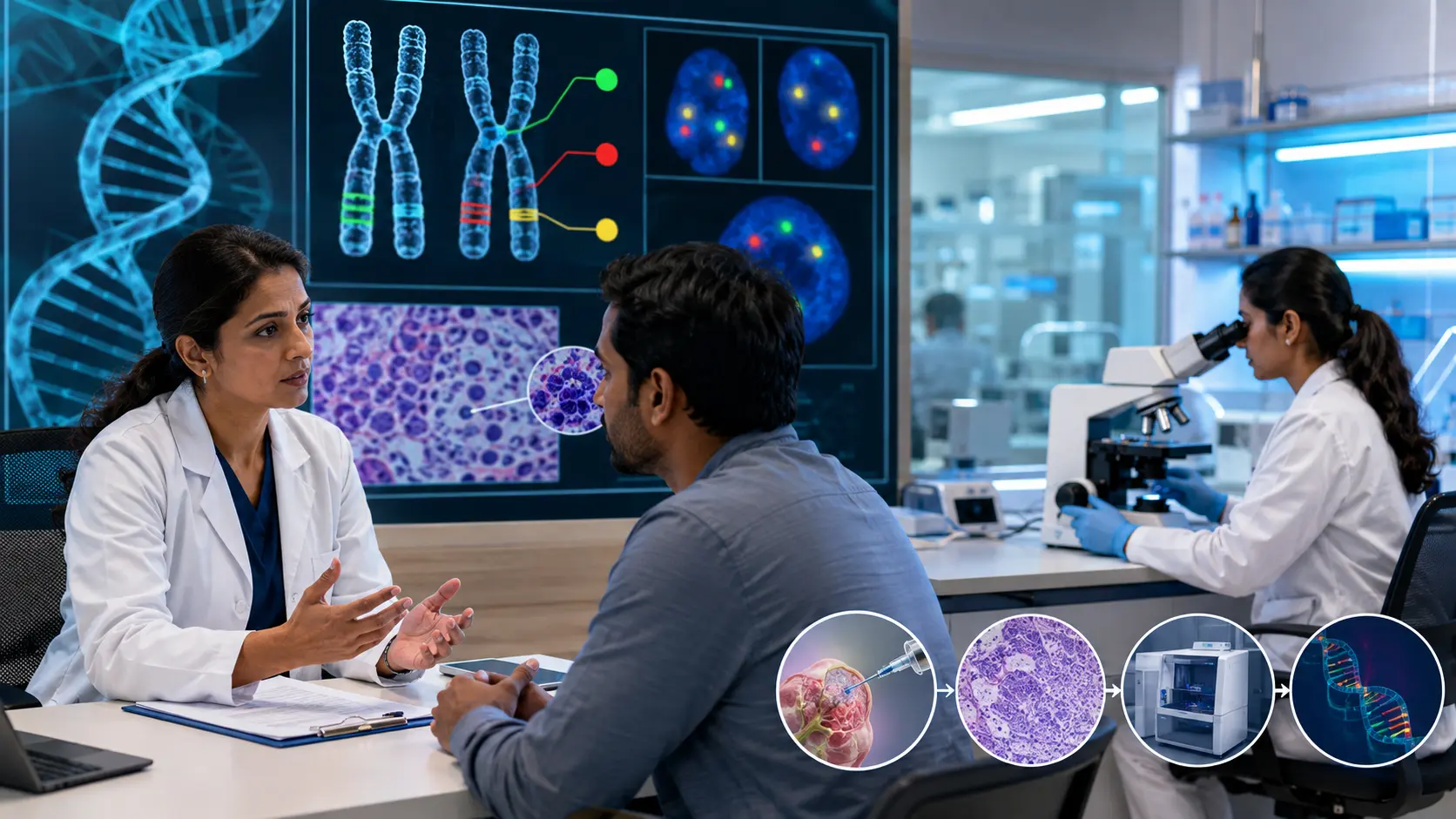
Aggressive Lymphoma: Can Genetic Testing Bring New Hope to Patients Facing a Difficult Diagnosis?
At a Glance
- Sample Required: [Insert Sample Type – e.g., Bone Marrow Aspirate, Peripheral Blood, or Tissue Biopsy]
- Fasting Rules: [Insert Fasting Requirement – e.g., No fasting required]
- Turnaround Time (TAT): [Insert TAT – e.g., 7-10 days]
- Base Cost: [Insert Current 2026 Price]
When lymphoma is diagnosed, one of the hardest questions for patients and families is not simply “Is it cancer?” but “Exactly what type of lymphoma is it, and how aggressive could it be?”
For some aggressive B-cell lymphomas, answering that question requires looking beyond what the cells look like under a microscope. Modern pathology can combine tissue examination, immunohistochemistry (IHC), flow cytometry, and molecular testing to uncover genetic changes that help classify the disease more precisely.
One important technique is fluorescence in situ hybridization (FISH). In aggressive B-cell lymphomas, FISH can identify rearrangements involving genes such as MYC, BCL2, and BCL6—changes that can have important diagnostic implications.
This is where genetic testing can offer something especially valuable: more information at a time when diagnostic uncertainty can be emotionally overwhelming.
What Makes a Lymphoma “Aggressive”?
Lymphoma is not one single disease. It includes many different subtypes, each with different biological behavior and clinical implications.
Aggressive lymphomas tend to grow and progress rapidly compared with indolent lymphomas. Among B-cell lymphomas, diffuse large B-cell lymphoma (DLBCL) is a common aggressive subtype, while some high-grade B-cell lymphomas have specific genetic abnormalities that distinguish them from other lymphomas.
That distinction matters because two lymphomas may appear similar initially but have different molecular characteristics.
As the Leukemia & Lymphoma Society notes, identifying the exact lymphoma subtype is important because different subtypes can have different prognoses and treatment approaches.
Where Do Genetics Enter the Picture?
Cancer develops when cells acquire genetic and molecular abnormalities that disrupt normal control of growth and survival.
In certain aggressive B-cell lymphomas, rearrangements involving MYC, BCL2, and BCL6 can provide important diagnostic information.
Think of chromosomes as highly organized instruction manuals. A gene rearrangement is somewhat like moving a chapter into a different location. The DNA sequence may still exist, but its new genomic context can alter how cellular growth signals are regulated.
What Is a FISH Test—and Why Is It Useful?
FISH stands for fluorescence in situ hybridization.
It is a laboratory technique that uses fluorescently labeled DNA probes to investigate specific genetic regions within cells.
Unlike a broad genetic test that looks across many genes, FISH can be designed to answer a focused clinical question:
“Is this particular gene rearrangement present?”
For aggressive B-cell lymphoma, FISH can be used to investigate important rearrangements involving genes such as MYC, BCL2, and BCL6. Professional guidelines identify FISH as an appropriate ancillary technique in lymphoma evaluation and subclassification.
Why Can This Matter After a Biopsy?
A biopsy can reveal the appearance and characteristics of lymphoma cells. IHC can show which proteins they express. FISH can add another layer of information by identifying specific chromosomal rearrangements.
Together, these findings can provide a more complete picture.
Biopsy → Morphology → IHC → Genetic Findings → Integrated Diagnosis
The important point is that genetic testing is generally not a replacement for pathology. It is one component of an integrated diagnostic process.
“Double-Expressor” and “Double-Hit” Are Not the Same Thing
This is one of the most important distinctions patients may encounter when reading about aggressive lymphoma.
A lymphoma may show increased expression of MYC and BCL2 proteins on immunohistochemistry. Such cases may be described as double-expressor lymphomas.
But this does not necessarily mean that MYC and BCL2 genes are rearranged.
A double-hit lymphoma, in contrast, refers to a lymphoma with specific gene rearrangements—classically involving MYC and BCL2 under current classification frameworks.
Therefore:
Protein expression ≠ Gene rearrangement.
IHC and FISH answer different biological questions, which is why both can be important in the appropriate diagnostic setting.
A New Generation of Lymphoma Diagnosis
Cancer genetics is changing how doctors understand lymphoma.
Researchers are increasingly studying molecular subgroups defined by combinations of mutations, structural variants, and other genomic alterations. However, broad next-generation sequencing (NGS) and whole exome sequencing (WES) are not yet universal substitutes for established diagnostic methods such as morphology, IHC, and targeted FISH. Instead, they serve as complementary tools that can provide deeper insights when standard testing is inconclusive or when specific therapeutic targets are being explored.
For many patients, the most useful genetic test is therefore not necessarily the broadest test available—but the test that answers the right clinical question.
Comparison of Diagnostic Techniques in Aggressive B-Cell Lymphoma
| Technique | What It Detects | Role in Diagnosis |
|---|---|---|
| Immunohistochemistry (IHC) | Protein expression (e.g., MYC, BCL2, BCL6) | Identifies cell lineage and protein overexpression; helps classify lymphoma subtype |
| FISH | Specific gene rearrangements (MYC, BCL2, BCL6) | Detects chromosomal translocations; distinguishes double-hit from double-expressor |
| Next-Generation Sequencing (NGS/WES) | Mutations, copy number alterations, and structural variants across many genes | Provides broader genomic profile; useful for research, targeted therapy selection, and when FISH is negative but suspicion remains |
When Might a FISH Aggressive Lymphoma Panel Be Considered?
When a patient has a suspected or confirmed aggressive B-cell lymphoma, the treating physician and pathologist may consider targeted FISH testing as part of the diagnostic workup or subclassification.
A panel evaluating relevant rearrangements can help investigate abnormalities involving MYC, BCL2, and BCL6, depending on the laboratory's panel and the clinical indication.
Professional guidelines support the use of FISH in the evaluation and subclassification of lymphoma, while current pathology protocols emphasize the importance of MYC/BCL2 genetic assessment in appropriate large B-cell lymphoma cases.
For more information about the FISH Aggressive Lymphoma Panel Test, readers can explore the DNA Labs India test page:
https://dnalabsindia.com/test/fish-aggressive-lymphoma-panel-test
Frequently Asked Questions
- What is aggressive lymphoma?
Aggressive lymphoma is a fast-growing type of lymphoma that may require prompt diagnosis and treatment. Accurate classification can involve biopsy, immunohistochemistry, and genetic testing. - What is FISH testing for aggressive lymphoma?
FISH (fluorescence in situ hybridization) is a genetic test that can detect specific gene rearrangements associated with aggressive B-cell lymphomas, including MYC, BCL2, and BCL6. - Why is FISH testing important in aggressive B-cell lymphoma?
FISH can provide genetic information that helps distinguish certain lymphoma subtypes and may contribute to more accurate disease classification. - What genes are tested in an aggressive lymphoma FISH panel?
Depending on the laboratory panel and clinical indication, testing may evaluate rearrangements involving MYC, BCL2, and BCL6.
Why Choose DNA Labs India?
DNA Labs India is an ISO 9001 certified laboratory committed to delivering accurate and reliable genetic testing services. Our team of experienced pathologists and geneticists ensures that each test is performed with the highest standards of quality and precision.
Written by: Dr. [Author Name]
Medically Reviewed by: Dr. [Reviewer Name]
Last Updated: [Date]