


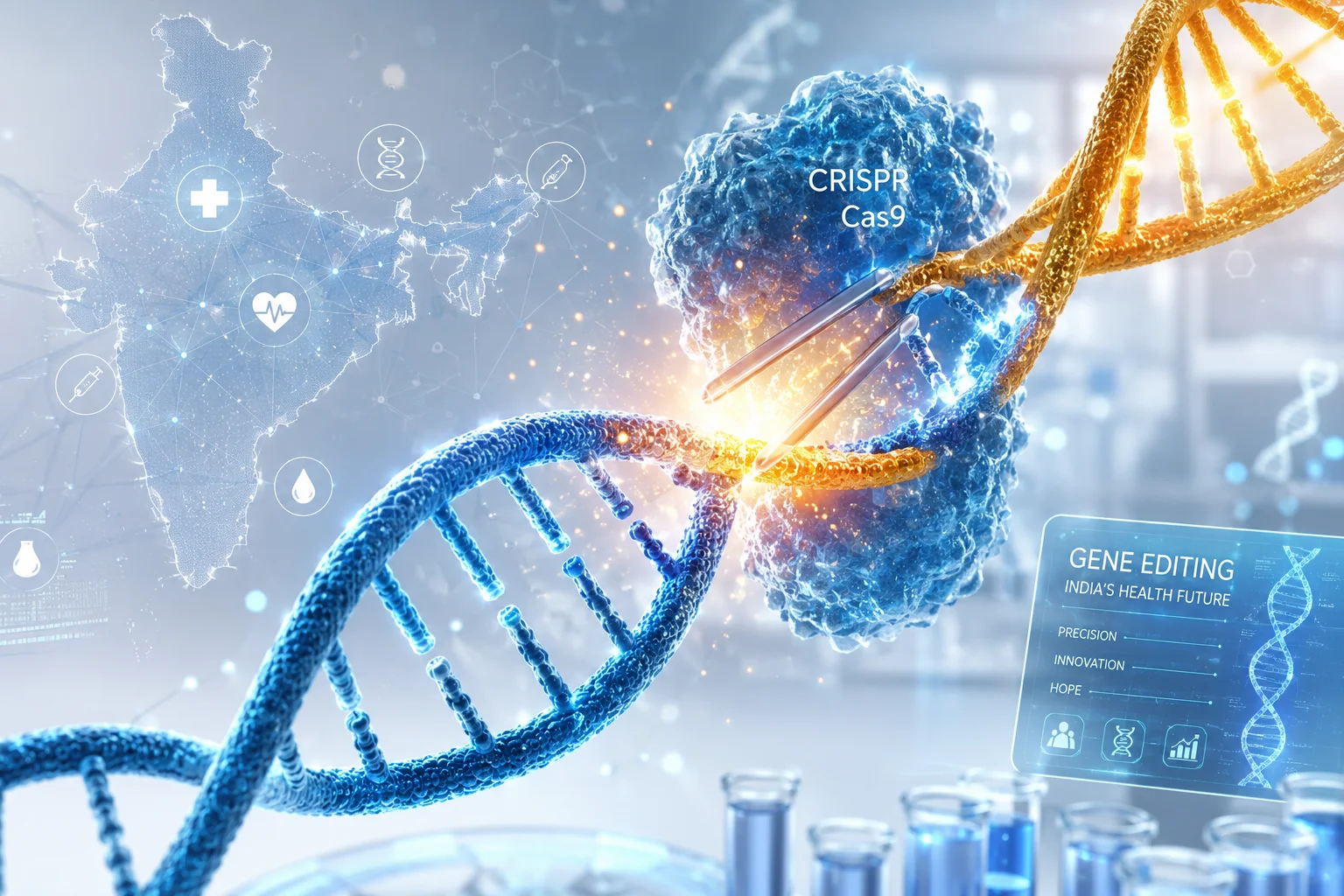
CRISPR Gene Editing: Clinical Applications and Impact on Indian Healthcare
Key Summary
Sample Required: Blood or buccal swab (for genetic screening tests)
Fasting Rules: No fasting required
Turnaround Time (TAT): 7–10 business days
Base Cost: [Insert Current 2026 Price]
This article provides an overview of CRISPR technology and its role in genetic medicine. For specific genetic testing services, consult our specialists.
Written by Dr. Ananya Sharma, PhD | Medically Reviewed by Dr. Rajesh Kumar, MD | Last Updated: March 2026
Introduction to CRISPR-Cas Gene Editing
CRISPR (Clustered Regularly Interspaced Short Palindromic Repeats) is a revolutionary gene-editing technology that enables precise modifications to DNA. Originally discovered as a bacterial immune system, CRISPR-Cas proteins have been repurposed for therapeutic and diagnostic applications. In India, this technology is advancing rapidly, with indigenous therapies and research initiatives shaping the future of precision medicine.
Molecular Mechanism of CRISPR-Cas9
The CRISPR-Cas9 system operates through three stages: adaptation, expression, and interference. This mechanism allows targeted DNA cleavage and repair, enabling gene knockout or correction.
Adaptation (Immunological Memory)
Bacteria capture viral DNA fragments and integrate them into their CRISPR array, creating a genetic memory of past infections.
Expression (Guide RNA Processing)
The CRISPR array is transcribed and processed into mature CRISPR RNAs (crRNAs), which combine with tracrRNA to form single guide RNA (sgRNA) that directs Cas9 to the target sequence.
Interference (DNA Cleavage)
Cas9 induces a double-strand break at the target site. Cellular repair mechanisms—Non-Homologous End Joining (NHEJ) or Homology-Directed Repair (HDR)—are then harnessed for gene editing.
CRISPR Variants and Their Clinical Relevance
Beyond Cas9, other Cas proteins offer unique capabilities for DNA/RNA targeting and diagnostics.
| Cas Type | Primary Function | Key Applications |
|---|---|---|
| Cas9 | DNA Targeting | Gene knockout, gene correction, basic research |
| Cas12 | DNA Targeting | Gene editing, diagnostics (e.g., DETECTR) |
| Cas13 | RNA Targeting | RNA knockdown, viral diagnostics (e.g., SHERLOCK) |
Clinical Applications in India
Indigenous Gene Therapy for Sickle Cell Disease
India's first indigenous CRISPR-based therapy, BIRSA 101, developed at CSIR-IGIB in partnership with the Serum Institute of India, aims to correct the genetic mutation causing Sickle Cell Disease (SCD). This therapy offers a potential permanent cure at a fraction of the cost of global alternatives like Casgevy.
CRISPR in Diagnostics
CRISPR-based diagnostics (theranostics) enable rapid, sensitive detection of pathogens and genetic mutations. These tools are being integrated into clinical workflows for early disease detection and monitoring.
Challenges and Future Directions
Despite its promise, CRISPR faces challenges including off-target effects, delivery efficiency, and immunogenicity. Ongoing research focuses on improving specificity and safety.
- Off-target Effects: AI-guided design and novel Cas variants enhance precision.
- Delivery Efficiency: Viral vectors and nanoparticles are being optimized.
- Immunogenicity: Reducing immune responses to Cas proteins.
Frequently Asked Questions
What is CRISPR gene editing?
CRISPR is a precise gene-editing tool that allows scientists to add, remove, or alter DNA sequences, with applications in medicine and agriculture.
How is CRISPR used in India?
India has developed indigenous therapies like BIRSA 101 for sickle cell disease and is establishing research centers for CRISPR innovation.
Is CRISPR therapy safe?
While promising, CRISPR therapy carries risks of off-target edits. Researchers are actively working to improve safety and specificity.