


DNA Methylation Explained: What Your MTHFR, COMT and Homocysteine Genes Reveal About Your Health
At a Glance
- Sample Required: Blood (EDTA) or Saliva
- Fasting Rules: Not required
- Turnaround Time (TAT): 7-10 working days
- Base Cost: [Insert Current 2026 Price]
Written by: Dr. [Name], Medical Geneticist | Medically Reviewed by: Dr. [Name] | Last Updated: [Date]
If you've had a doctor order a homocysteine test, or you've wondered why some people feel "wired but tired" no matter how clean their diet is, the answer often traces back to a single biochemical process running quietly in every cell of your body: DNA methylation.
Methylation isn't just a buzzword borrowed from epigenetics research. It's the mechanism your body uses to activate folate, recycle vitamin B12, clear excess homocysteine, break down stress hormones, and switch genes on or off in response to your environment. And because this entire system runs on a handful of enzymes coded by specific genes, small genetic variations — single nucleotide polymorphisms, or SNPs — can shift how efficiently the whole pathway operates.
This is especially relevant in the Indian context. India carries one of the world's highest documented burdens of vitamin B12 insufficiency, alongside a largely plant-based dietary pattern that changes how methylation genes express themselves in practice. Understanding the biology behind this — not just the vitamin levels — is where genetic insight adds real clinical value.
What Is DNA Methylation, and Why Does It Run So Much of Your Biology?
At its core, methylation is the transfer of a single-carbon "methyl" group (–CH3) onto DNA, proteins, or small molecules. This tiny chemical tag has an outsized job:
- It switches genes on or off without altering the underlying DNA sequence — the foundation of epigenetics.
- It converts homocysteine, a byproduct of protein metabolism, back into methionine — an amino acid your body reuses to make SAMe (S-adenosylmethionine), the universal methyl donor for hundreds of reactions.
- It regulates neurotransmitter clearance, including dopamine, adrenaline, and estrogen metabolites.
- It supports liver detoxification and the synthesis of choline, creatine, and carnitine.
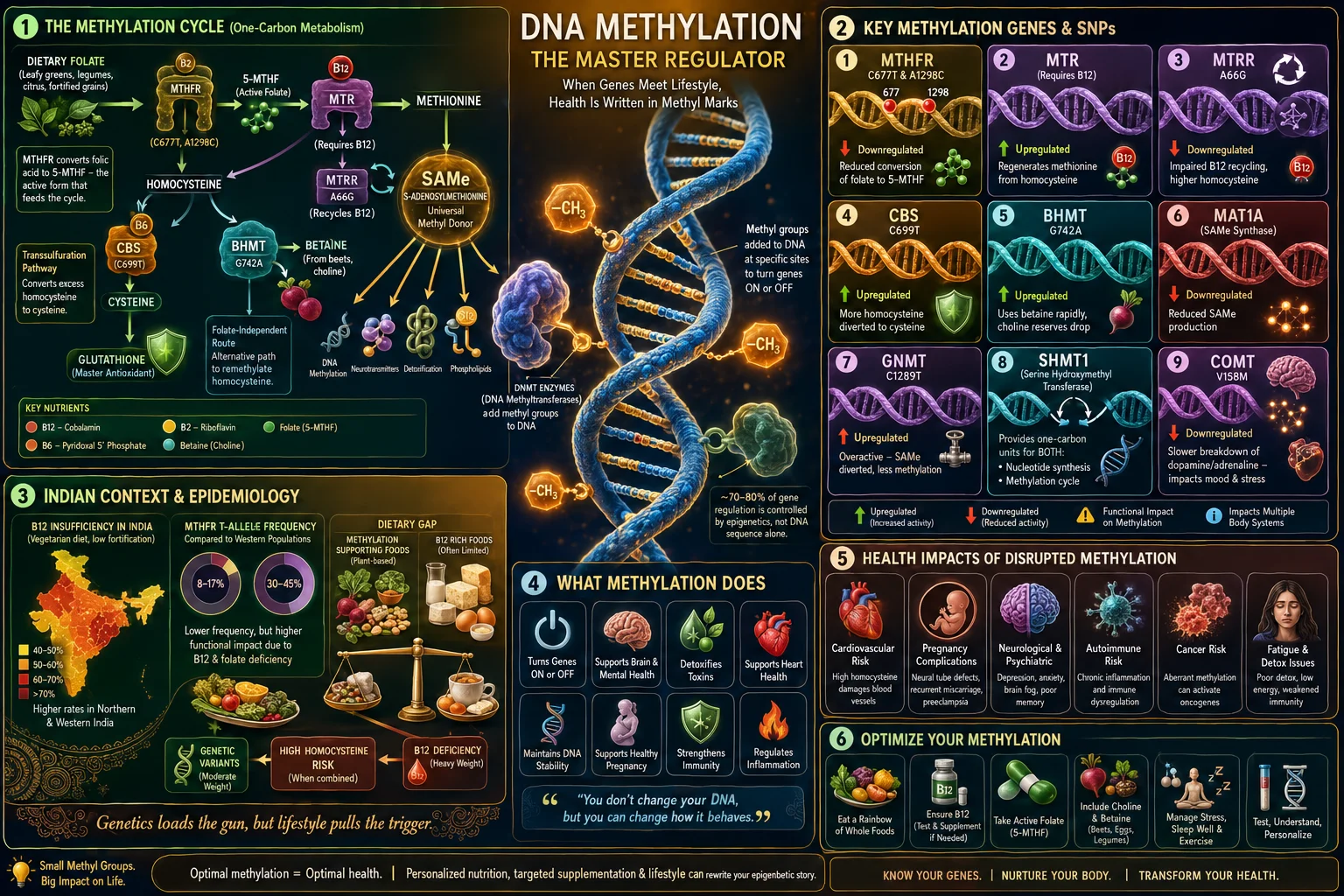
All of this runs on what biochemists call the one-carbon cycle — a folate- and B12-dependent loop that shuttles methyl groups between molecules. The genes discussed below each control a different checkpoint in that loop.
The One-Carbon Cycle Gene Panel: Meet the Molecular Machinery
Folate Activation — MTHFR (C677T & A1298C)
MTHFR converts dietary folate into its active, usable form (5-MTHF), which is required to convert homocysteine back into methionine. Reduced MTHFR activity — seen with the C677T and A1298C variants — is one of the most researched links to elevated homocysteine, cardiovascular risk, and neural tube defect risk in pregnancy.
Here's where India tells a different story than the West: studies across Indian population groups, from Rajasthan to Manipur to South India, consistently report a T-allele frequency of roughly 8–17% — notably lower than the 30–45% seen in Caucasian and East Asian populations. On paper, that sounds reassuring. In practice, India's high background rate of B12 and folate insufficiency means even a partially reduced MTHFR enzyme can tip the balance toward elevated homocysteine, because the raw materials the enzyme needs are already in short supply.
Homocysteine-to-Cysteine — CBS (C699T)
Cystathionine beta-synthase (CBS) diverts homocysteine down the transsulfuration pathway, converting it into cysteine and eventually glutathione — your body's master antioxidant. The C699T variant is generally associated with increased CBS activity, which can be protective by helping clear homocysteine. But an overactive transsulfuration pathway also has a trade-off: it can pull methyl groups and sulfur amino acids away from the methylation cycle, sometimes increasing the need for B6 and molybdenum to keep downstream detox pathways balanced.
B12 Recycling — MTR and MTRR
MTR (methionine synthase) performs the final step that regenerates methionine from homocysteine, using vitamin B12 as a cofactor. MTRR keeps the B12-dependent form of MTR active. Variants here — such as MTRR A66G — reduce B12 recycling efficiency, meaning a person may need more dietary or supplemental B12 to maintain normal methylation flux than someone without the variant.
This is precisely where Indian epidemiology intersects with genetics most sharply. Multiple hospital-based and population studies report vitamin B12 insufficiency in 40–70% of Indian adults, with figures climbing higher still among strict vegetarians. A genetically less efficient B12-recycling step, layered on top of already-low dietary B12 intake, compounds risk in a way that a Western reference range often fails to capture.
Liver Methylation Reserve — BHMT, MAT1A, and GNMT
These three genes govern a secondary, liver-dominant route for handling homocysteine and methyl groups:
- BHMT offers a folate-independent shortcut, using betaine (from beets, spinach, and whole grains) to convert homocysteine to methionine. Variants that upregulate BHMT can lower homocysteine efficiently, but may draw down the body's choline reserves faster than diet replenishes them.
- MAT1A converts methionine into SAMe, the master methyl donor. Reduced MAT1A activity limits SAMe availability system-wide, with downstream effects on liver methylation capacity, especially when combined with a high-fat diet.
- GNMT acts as a "pressure-release valve," disposing of excess SAMe when methyl supply outpaces demand. An overactive GNMT variant burns through SAMe faster, which can, over time, raise homocysteine again despite adequate folate and B12 status.
Genome Stability — SHMT1
SHMT1 sits at a fork in the one-carbon road: it can either push folate toward nucleotide (DNA) synthesis or toward the methylation cycle. Variants that reduce SHMT1 activity favor methylation at the expense of nucleotide synthesis — the opposite trade-off of what many people assume, and a reminder that "more methylation" isn't automatically the healthier direction for every gene in this pathway.
Neurotransmitter and Hormone Clearance — COMT (V158M)
COMT breaks down dopamine, adrenaline, noradrenaline, and estrogen metabolites using SAMe as its methyl donor. The V158M variant reduces COMT enzyme activity considerably, slowing the clearance of these molecules. This has been studied in relation to mood regulation, stress resilience, pain sensitivity, and estrogen metabolism — making COMT one of the more clinically discussed genes outside the strict homocysteine conversation, even though it draws on the exact same SAMe pool as the rest of the pathway.
Gene Panel Summary
| Gene | Variant | Function | Effect |
|---|---|---|---|
| MTHFR | C677T, A1298C | Folate activation | Downregulation → reduced 5-MTHF, elevated homocysteine |
| CBS | C699T | Homocysteine transsulfuration | Upregulation → lower homocysteine, but may deplete B6 and molybdenum |
| MTR/MTRR | A66G | B12 recycling | Downregulation → reduced B12 efficiency, higher B12 requirement |
| BHMT | G742A | Folate-independent homocysteine remethylation | Upregulation → lower homocysteine, but increased choline demand |
| MAT1A | Various | SAMe synthesis | Downregulation → reduced SAMe availability |
| GNMT | C1289T | SAMe disposal | Upregulation → faster SAMe depletion, potential homocysteine rise |
| SHMT1 | Various | Folate partitioning | Downregulation → favors methylation over nucleotide synthesis |
| COMT | V158M | Catecholamine and estrogen clearance | Downregulation → slower clearance, higher stress sensitivity |
Upregulation vs. Downregulation: Why Direction Matters More Than "Good" or "Bad"
A common misconception is that every methylation gene variant is simply "faulty." In reality, each SNP either speeds up (upregulates) or slows down (downregulates) its enzyme, and both directions carry trade-offs:
- Downregulating variants (like MTHFR C677T, MTRR A66G, MAT1A, COMT V158M) slow their enzyme, which can cause substrates like homocysteine or catecholamines to accumulate.
- Upregulating variants (like CBS C699T, BHMT G742A, GNMT C1289T) speed up their enzyme, which can lower homocysteine but sometimes at the cost of depleting a related resource — choline, SAMe, or B6 — faster than the diet supplies it.
This is why methylation genetics is never read gene-by-gene in isolation. A downregulating MTHFR variant paired with an upregulating CBS variant produces a very different biochemical picture than the same MTHFR variant paired with a downregulating CBS variant. The pathway has to be interpreted as a network, not a checklist.
It's also worth being precise about what these associations mean: most of the links above — to cardiovascular disease, mood disorders, cancers, or pregnancy complications — come from population-level case-control studies. They describe statistical associations across large groups, not individual predictions. A variant shifts probability; it does not diagnose a condition or guarantee an outcome.
Why This Genetic Story Reads Differently in India
Three overlapping realities make methylation genetics particularly relevant for the Indian population:
- A predominantly plant-based diet. Vitamin B12 has no plant source, and India has some of the highest documented B12 insufficiency rates in the world — with several hospital-based studies reporting deficiency in roughly half to over two-thirds of vegetarian adults tested.
- Comparatively lower MTHFR mutation frequency, but higher functional impact. Indian population studies place the MTHFR 677T allele frequency around 8–17%, lower than Western populations. But with folate and B12 status already under pressure from diet, even a moderately reduced enzyme has less buffer room to compensate.
- Rising cardiometabolic and mood-related concerns. As lifestyle patterns shift — more processed food, more sedentary time, more chronic stress — the downstream pathways that methylation genes regulate (homocysteine clearance, catecholamine breakdown, liver detoxification) are under more daily load than they were a generation ago.
Put together, this means an Indian patient's methylation genetics can't simply be interpreted by importing a Western reference framework. The dietary backdrop changes what a given SNP is likely to mean in practice.
Busting the Biggest Methylation Myth
Methylation genetics — and MTHFR in particular — has been heavily popularized in wellness and functional-medicine circles, sometimes with claims that outpace the evidence: that a single MTHFR variant "causes" chronic fatigue, infertility, or depression on its own, or that everyone with a variant needs aggressive supplementation.
The clinical reality is more measured. A gene variant describes potential enzyme efficiency — it doesn't replace measuring the actual downstream markers that matter: fasting homocysteine, active B12 (holotranscobalamin), folate status, and methylmalonic acid where indicated. Genetics tells you why a lab value might be trending a certain way; it is the biochemistry, interpreted by a qualified clinician, that tells you what to actually do about it.
From Genotype to Everyday Choices
Because this pathway is nutrient-dependent, several general, well-established levers influence how it functions day to day:
- Folate-rich whole foods (leafy greens, legumes, citrus) support the MTHFR step, though the form of folate matters for those with reduced MTHFR activity.
- Reliable B12 intake is a particular priority for vegetarians and vegans, given how widespread subclinical B12 insufficiency already is across India.
- Choline-containing foods (eggs, dairy, peanuts) matter more for people with upregulated BHMT activity, since that pathway draws on choline reserves.
- Moderating alcohol intake supports the transsulfuration and liver detoxification pathways that CBS, GNMT, and MAT1A all feed into.
- Managing chronic stress matters for anyone with reduced COMT activity, since catecholamine clearance is already running slower.
These are general physiological principles, not individualized medical advice — the right approach for any one person depends on their actual genotype combination and lab markers together.
From Curiosity to Clarity
DNA methylation is a beautiful example of how genes and environment interact. At DNA Labs India, we offer comprehensive methylation gene panels using Next-Generation Sequencing (NGS) to analyze key SNPs in MTHFR, CBS, MTR, MTRR, BHMT, MAT1A, GNMT, SHMT1, and COMT. Our ISO 9001 certified lab ensures accurate and reliable results, interpreted by expert medical geneticists.
If you're ready to understand your methylation pathway and how it impacts your health, consult with our specialists. We'll help you interpret your genetic profile in the context of your lifestyle and biochemical markers.