


The Genetic Architecture of Parkinson's Disease: Why Early Testing Matters in India
At a Glance: Parkinson's Disease Genetic Test
- Sample Required: Whole blood (EDTA) or saliva sample
- Fasting Rules: No fasting required
- Turnaround Time (TAT): 15-20 working days
- Base Cost: [Insert Current 2026 Price]
Written by: Dr. [Name], Medical Geneticist
Medically Reviewed by: Dr. [Name], Neurologist
Last Updated: [Date]
Parkinson's disease (PD) has long been characterized as a neurodegenerative disorder with an unknown cause in the vast majority of cases. However, this clinical paradigm is shifting rapidly. Recent research reveals that genetics play a far more significant role in Parkinson's disease than previously understood, with studies suggesting that up to 15-20% of early-onset cases in India may have an identifiable genetic basis. This fundamental change in our understanding of the disease is transforming how we approach diagnosis, risk assessment, and potential therapeutic interventions.
Understanding Parkinson's Disease: Beyond the Motor Symptoms
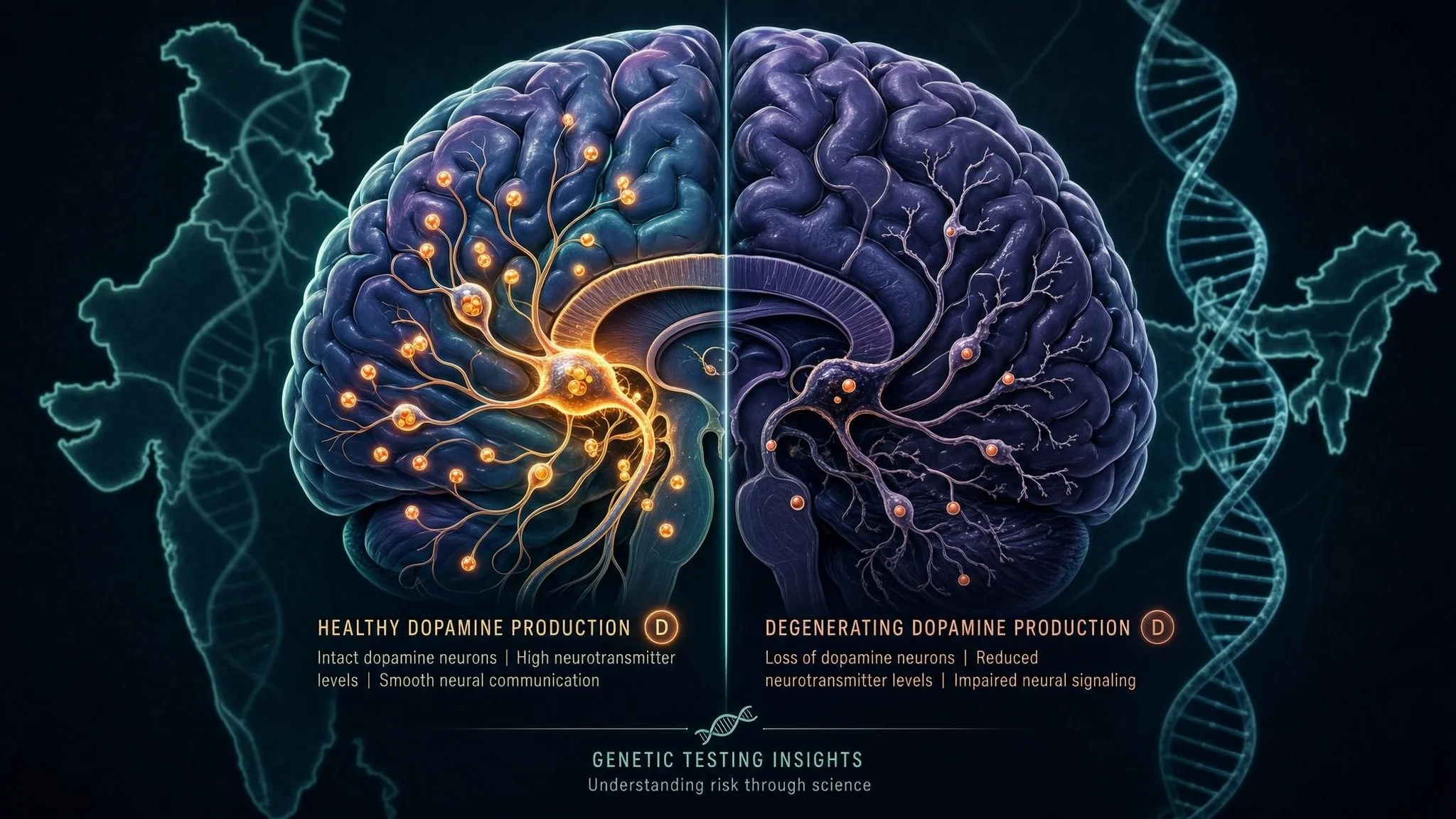
Parkinson's disease is a progressive neurological disorder that affects the nervous system and the parts of the body controlled by the nerves. The condition is caused by the progressive loss of dopamine-producing neurons in the brain, particularly in the substantia nigra pars compacta region. Dopamine is a critical neurotransmitter that helps regulate movement, motivation, and emotional responses. When approximately 60-80% of these neurons are lost, the characteristic motor symptoms become clinically evident.
The symptoms of Parkinson's disease typically develop gradually and may initially be subtle:
- Tremor: Rhythmic shaking usually begins in a limb, often the hand or fingers, and may present as a "pill-rolling" tremor where the thumb and forefinger rub back and forth. This tremor typically occurs at rest and may decrease when performing tasks.
- Slowed movement (Bradykinesia): Simple tasks become difficult and time-consuming. Walking may involve shorter steps, and getting out of a chair can become challenging.
- Muscle Rigidity: Stiffness may occur in any part of the body, causing pain and limiting the range of motion.
- Impaired Posture and Balance: Posture may become stooped, and balance problems can lead to falls.
- Loss of Automatic Movements: There may be a decreased ability to perform unconscious movements, including blinking, smiling, or swinging the arms while walking.
- Speech and Writing Changes: Speech may become soft, slurred, or monotone, and handwriting may appear smaller.
Beyond these motor symptoms, Parkinson's disease can also cause depression, difficulty speaking, and other non-motor manifestations.
The Indian Parkinson's Disease Landscape: A Growing Concern
India faces a particularly significant burden of Parkinson's disease. According to the Global Burden of Disease study (2016), approximately 575,946 people were living with Parkinson's disease in India, representing nearly 9.5% of the global PD population. Current prevalence rates in India range from 15 to 43 per 100,000 people. Notably, 40-45% of Indian patients report early-onset symptoms between the ages of 22 and 49, significantly younger than the global average. This early manifestation, coupled with lifestyle changes, genetic predisposition, and increasing life expectancy, is projected to contribute to a 200-300% surge in Parkinson's cases across India in the coming decades.
This demographic shift has profound implications for affected individuals, their families, and the healthcare system. Younger-onset patients face unique challenges, including longer disease duration, potential impacts on career and family planning, and distinct disease characteristics.
The Genetic Revolution in Parkinson's Understanding
The Paradigm Shift
For decades, Parkinson's disease was viewed as primarily an environmental or idiopathic condition. However, the discovery of a pathogenic variant in the alpha-synuclein (SNCA) gene in the Contursi kindred in 1997 indisputably confirmed a genetic cause in at least a subset of PD patients. Since then, our understanding of the genetic architecture of Parkinson's disease has expanded dramatically.
Currently, pathogenic variants in one of seven established PD genes or the strongest known risk factor gene, GBA1, are identified in approximately 15% of PD patients unselected for age at onset and family history. This has led some researchers to argue that Parkinson's disease is "predominantly a genetic disease".
Key Genes Implicated in Parkinson's Disease
Modern genetic testing panels for Parkinson's disease, such as the Parkinson Disease Panel NGS Genetic Test offered by DNA Labs India, analyze multiple genes known to be associated with the condition. A comprehensive panel may examine up to 94 genes and variants, providing a thorough genetic assessment.
| Gene | Inheritance | Clinical Significance |
|---|---|---|
| SNCA | Autosomal dominant | First gene identified; causes familial PD |
| LRRK2 | Autosomal dominant | Found in ~1% of all PD; higher in certain populations |
| VPS35 | Autosomal dominant | Associated with familial PD, especially in Western European ancestry |
| PRKN (Parkin) | Autosomal recessive | Biallelic mutations account for 3-5% of early-onset PD in India |
| PINK1 | Autosomal recessive | Causes early-onset PD |
| PARK7 (DJ-1) | Autosomal recessive | Associated with early-onset PD |
| GBA1 | Risk factor | Up to 10% of Indian PD patients carry variants; faster progression |
India-Specific Genetic Findings
Recent research has revealed unique aspects of the genetic landscape of Parkinson's disease in India. Studies have detected rare genetic variants in 15-20% of early-onset PD patients in India. However, due to a lack of segregation analysis and functional validation, a vast majority of these remain classified as variants of uncertain significance (VUS).
Several potentially pathogenic variants detected in Indian PD patients are not yet cited in global genetic databases such as the Movement Disorder Society Genetic mutation database. This suggests the possibility of population-specific genetic factors contributing to Parkinson's disease in India.
A particularly notable finding from India's largest young-onset Parkinson's study (GOPI-YOPD), which analyzed 668 early-onset patients across 10 medical centers, has confirmed the rising incidence of early-onset PD in India. The study has spotlighted a novel player—the BSN gene—found to be more relevant in South Asian populations.
Genetic Testing for Parkinson's Disease: What It Can Reveal
The Role of Next-Generation Sequencing
Next-generation sequencing (NGS) technology has revolutionized genetic testing for Parkinson's disease. Multigene panels using NGS are now the first choice for genetic testing in clinical settings. NGS allows for simultaneous analysis of multiple genes associated with Parkinson's disease, providing a comprehensive genetic profile in a single test.
The technology works by sequencing the DNA from a patient's blood sample, identifying any mutations or variants in genes known to be associated with Parkinson's disease. This approach is far more efficient and informative than testing for single genes sequentially.
Clinical Utility of Genetic Testing
Genetic testing for Parkinson's disease serves multiple purposes:
- Confirming a Diagnosis: For individuals with clinical symptoms, identifying a pathogenic genetic variant can confirm the diagnosis and distinguish PD from other parkinsonian disorders.
- Identifying At-Risk Family Members: Genetic testing can identify family members who may be at risk of developing the condition, allowing for early intervention and informed family planning decisions.
- Guiding Prognosis: Certain genetic variants, such as GBA1 mutations, are associated with faster progression and poorer prognosis.
- Informing Treatment Decisions: Several interventional clinical trials are active for carriers of LRRK2 and/or GBA1 mutations, and future treatment approaches may be personalized based on genetic profile.
- Providing Reproductive Options: Genetic testing can allow for informed reproductive choices, including preimplantation genetic diagnosis and prenatal testing.
Eligibility for Genetic Testing
International guidelines suggest that genetic testing for Parkinson's disease should be considered for individuals who meet certain criteria. In the United Kingdom, for example, testing is available through the NHS for people who have a Parkinson's diagnosis before the age of 50, have a first-degree relative diagnosed before the age of 50, or have complex features.
Given the high prevalence of early-onset Parkinson's disease in India, genetic testing may be particularly relevant for younger individuals presenting with symptoms.
The Path Forward: Navigating the Diagnostic Journey
The shift towards a biological understanding of Parkinson's disease represents a paradigm change. Recent research frameworks, such as the "SynNeurGe" classification system and the "NSD-ISS" staging system, propose defining Parkinson's disease based purely on its biological hallmarks—including genetic markers—independent of clinical manifestations.
These frameworks aim to detect the disease at a "biologically early phase," potentially years before motor symptoms appear, creating a window for disease-modifying therapies. However, the authors acknowledge that broad clinical application of these frameworks remains premature and requires prospective validation.
For individuals in India concerned about Parkinson's disease, the Parkinson Disease Panel NGS Genetic Test offers a comprehensive genetic assessment. The test analyzes a carefully curated panel of genes known to be associated with Parkinson's disease, including those with established clinical validity as well as emerging genetic markers.
Conclusion
Parkinson's disease in India presents a unique and growing challenge. With a high prevalence of early-onset cases and a projected surge in cases in coming decades, understanding the genetic underpinnings of the disease is essential for effective diagnosis, management, and prevention.
Genetic testing for Parkinson's disease has evolved from a research tool to an increasingly important clinical instrument. For individuals with symptoms suggestive of Parkinson's disease, particularly those with early onset or a family history, genetic testing can provide definitive answers and guide clinical management.
The Parkinson Disease Panel NGS Genetic Test offered by DNA Labs India provides a comprehensive genetic analysis using state-of-the-art technology. By identifying genetic mutations associated with Parkinson's disease, this test can help patients and clinicians make informed decisions about treatment and family planning.