

Understanding Facioscapulohumeral Muscular Dystrophy (FSHD): A Guide for the Indian Population
Written by Dr. Ananya Sharma | Medically Reviewed by Dr. Rajesh Kumar | Last Updated:
At a Glance: FSHD Genetic Testing
- Sample Required: 2-3 mL EDTA whole blood
- Fasting Rules: None required
- Turnaround Time (TAT): 2-3 weeks
- Base Cost: [Insert Current 2026 Price]
Facioscapulohumeral muscular dystrophy (FSHD) is one of the most prevalent muscular dystrophies, yet it remains widely underdiagnosed, particularly in India. Characterized by progressive muscle weakness, it primarily affects the face, shoulders, and upper arms. For the Indian population, understanding this condition is the first critical step toward timely diagnosis and management.
Clinical Presentation and Symptom Progression
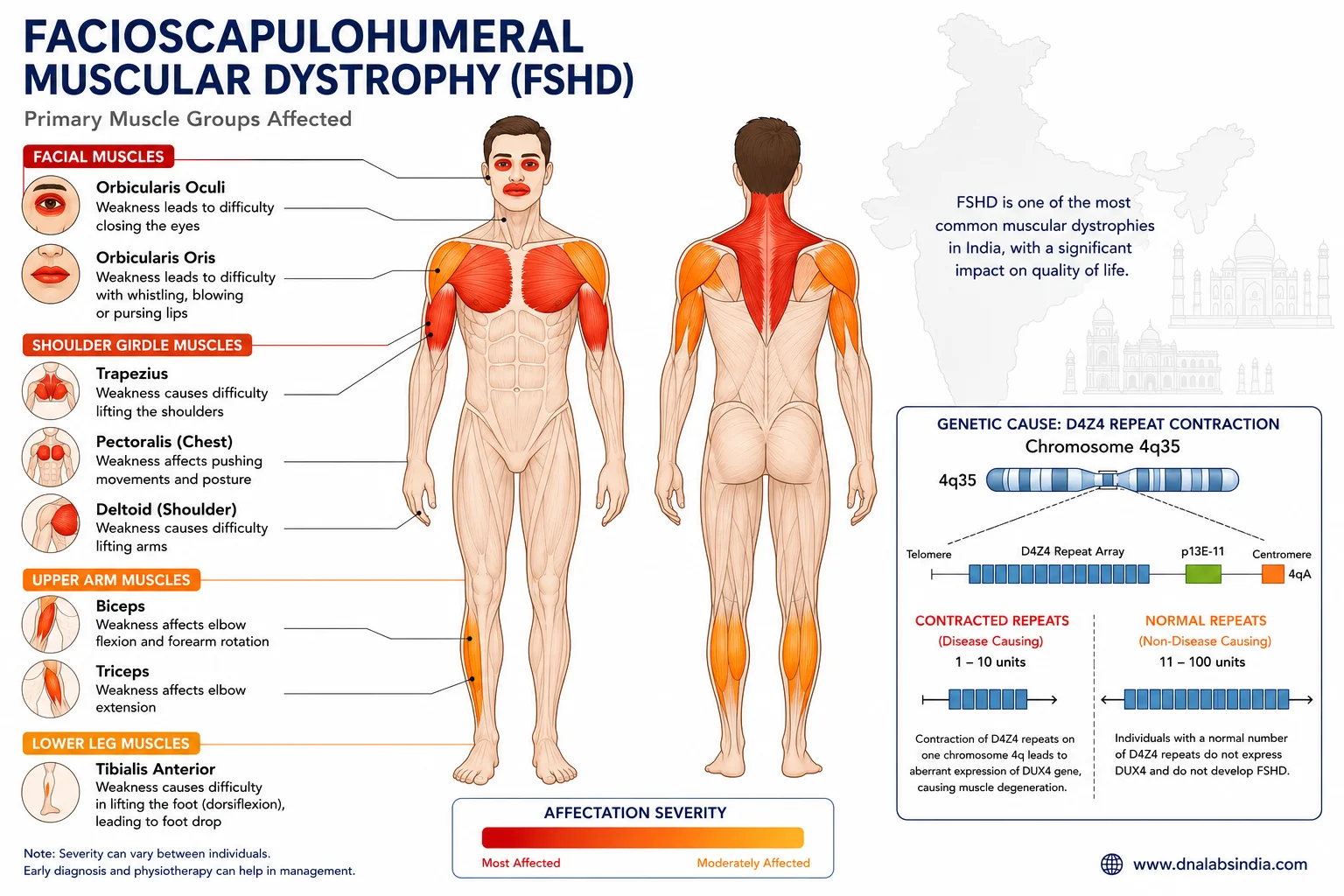
FSHD is a genetic muscle disorder that causes progressive weakening and wasting (atrophy) of skeletal muscles. The name itself describes the pattern of muscle involvement:
- Facio-: Muscles of the face.
- Scapulo-: Muscles around the shoulder blades (scapulae).
- Humeral: Muscles of the upper arms.
While these are the most commonly affected areas, the condition can also impact the muscles of the lower legs, hips, and abdomen over time. It is a slowly progressive condition, and the severity can vary dramatically from person to person, even within the same family.
Early and Common Symptoms
The earliest signs often involve the face and shoulders. You may notice difficulty with:
- Facial Expressions: Trouble smiling, whistling, or drinking through a straw. Some people may also have difficulty closing their eyes completely while sleeping.
- Shoulder and Arm Function: Difficulty raising the arms over the head, reaching for objects, or throwing a ball. A classic sign is scapular winging, where the shoulder blades protrude outward from the back.
Progressive Symptoms and Complications
As the condition progresses, muscle weakness can spread to other parts of the body:
- Lower Legs: Weakness in the foot dorsiflexors can cause foot drop, leading to a high-stepping gait and an increased risk of falls.
- Hips and Pelvis: This can make climbing stairs or walking long distances difficult. About 20% of individuals may eventually require a wheelchair.
- Abdomen: Weak abdominal muscles can lead to an exaggerated lower back curvature, known as lordosis, or a positive Beevor's sign.
Other Associated Features
While less common, some individuals may also experience:
- Mild high-frequency hearing loss.
- Retinal abnormalities.
- Rarely, cardiac or respiratory muscle involvement.
Molecular Pathogenesis of FSHD
To understand FSHD, it's helpful to look at the cellular level. The disease is caused by the inappropriate expression of a gene called DUX4 in adult muscle cells. This gene is normally active only in early embryonic development but is silenced in most adult tissues.
In FSHD, this silencing is disrupted. This disruption occurs through two main routes:
- Genetic Contraction (FSHD1): The D4Z4 region on chromosome 4 contains repeated units of DNA. In a healthy individual, there are more than 10 repeats. In FSHD1, this number is reduced to between 1 and 10 repeats. This contraction makes the D4Z4 region "epigenetically" looser, allowing for the DUX4 gene to be accidentally activated.
- Epigenetic Changes (FSHD2): In FSHD2, the D4Z4 region is not contracted, but it is abnormally low in methylation. This is an epigenetic change, meaning it alters how genes are expressed without changing the underlying DNA sequence. Mutations in genes like SMCHD1 or DNMT3B, which are responsible for adding methylation (DNA packaging), lead to this hypomethylation and subsequent DUX4 activation.
In both cases, the key to the disease is the presence of a "permissive" 4qA allele on chromosome 4, which provides the necessary signal to stabilize and express the toxic DUX4 protein.
FSHD1 vs. FSHD2: A Comparative Overview
| Feature | FSHD1 | FSHD2 |
|---|---|---|
| Prevalence | ~95% of cases | ~5% of cases |
| Genetic Cause | Contraction of D4Z4 repeat array (1-10 units) | Mutations in SMCHD1, DNMT3B, or LRIF1 leading to hypomethylation |
| D4Z4 Repeat Size | 1-10 units | >10 units (normal) |
| Methylation Status | Hypomethylated due to contraction | Hypomethylated due to gene mutations |
| Inheritance | Autosomal dominant | Autosomal dominant (with digenic inheritance) |
Genetic Diagnosis and Testing Modalities
Historically, FSHD diagnosis in India has been largely clinical. However, the advent of advanced molecular techniques is changing this landscape.
- Optical Genome Mapping (OGM): This newer technology offers a more convenient and simplified method to detect repeat contraction and 4q haplotypes simultaneously. It is now being offered at public institutions like CSIR-Centre for Cellular and Molecular Biology (CCMB) in Hyderabad and by some private diagnostic laboratories. OGM is simpler and faster compared to the traditional Southern blotting method.
- Next-Generation Sequencing (NGS): Targeted NGS panels can identify mutations in FSHD2-related genes (SMCHD1, DNMT3B, LRIF1) and also confirm the presence of the permissive 4qA allele.
- Addressing Underdiagnosis: The non-availability of diagnostic testing has long been a barrier in India. Increasing access to tests like OGM and targeted NGS is crucial to providing definitive diagnoses and enabling patients to access appropriate care and emerging clinical trials.
At DNA Labs India, we offer comprehensive genetic testing for FSHD using advanced molecular techniques. As an ISO 9001 certified lab, we ensure accurate and reliable results to guide clinical decisions.
FSHD in the Indian Population: Epidemiology and Genetic Insights
While global prevalence is estimated at 1 in 8,000 to 20,000 individuals, the picture in India is still emerging. Clinical experience and recent research suggest that FSHD may be more common than previously thought, though it has faced significant underdiagnosis due to a lack of accessible, specialized genetic testing.
Key Findings in the Indian Population
Recent studies, particularly from the International Centre for Genomic Medicine in Neuromuscular Diseases (ICGNMD), have provided crucial genetic insights specific to India:
- A Significant Genetic Burden: A cohort study at AIIMS New Delhi identified FSHD as one of the most genetically solved neuromuscular disorders, with 74 out of 789 probands (individuals in a study) diagnosed via genetic testing.
- Unique Genetic Thresholds: The classic threshold for an FSHD1 diagnosis is 1-10 D4Z4 units. However, research indicates the Indian population may have an intermediate susceptibility compared to European (1-10 units) and Northeast Asian (1-7 units) populations. This suggests that genetic counsellors may need to consider an individual's genetic background when interpreting test results.
- High Prevalence of Asymptomatic Carriers: The ICGNMD study found a "substantial proportion" of asymptomatic carriers with short FSHD1 alleles, suggesting lower penetrance in the Indian population and highlighting the importance of genetic testing for family members.
Management and Therapeutic Outlook
Currently, there is no cure for FSHD. Treatment focuses on managing symptoms, maintaining mobility, and improving quality of life through physical therapy, occupational therapy, and assistive devices. However, ongoing research and clinical trials are exploring potential therapeutic approaches, including gene therapy and small-molecule inhibitors targeting DUX4 expression.
Early diagnosis through genetic testing is crucial for appropriate management and family planning. Genetic counseling is recommended for affected individuals and their families to understand inheritance patterns and reproductive options.
Frequently Asked Questions About FSHD
1. What is the first sign of FSHD?
The earliest signs of FSHD typically involve the face and shoulders. Common initial symptoms include difficulty smiling, whistling, or drinking through a straw, as well as trouble raising the arms overhead. A classic early sign is scapular winging, where the shoulder blades protrude outward from the back.
2. Is FSHD a fatal disease?
FSHD is generally not considered fatal and does not significantly shorten life expectancy in most cases. However, in rare instances, severe respiratory muscle involvement can occur. Most individuals with FSHD have a normal lifespan, though quality of life can be significantly impacted by progressive muscle weakness.
3. What is the difference between FSHD Type 1 and Type 2?
FSHD Type 1 (FSHD1) accounts for approximately 95% of cases and is caused by a contraction of the D4Z4 repeat region on chromosome 4. FSHD Type 2 (FSHD2) is rarer, accounting for about 5% of cases, and is caused by mutations in genes like SMCHD1, DNMT3B, or LRIF1, which lead to similar epigenetic changes without the D4Z4 contraction.
4. How is FSHD diagnosed in India?
FSHD diagnosis in India has traditionally been clinical, but advanced molecular techniques are now available. These include Optical Genome Mapping (OGM), offered at institutions like CSIR-CCMB in Hyderabad and some private laboratories, as well as targeted Next-Generation Sequencing (NGS). These tests detect the specific genetic and epigenetic changes characteristic of FSHD.
5. Can FSHD be prevented or cured?
Currently, there is no cure for FSHD. Treatment focuses on managing symptoms, maintaining mobility, and improving quality of life through physical therapy, occupational therapy, and assistive devices. However, ongoing research and clinical trials are exploring potential therapeutic approaches.
6. What is the prevalence of FSHD in India?
While global prevalence is estimated at 1 in 8,000 to 20,000 individuals, the exact prevalence in India is still emerging. Recent research suggests FSHD may be more common than previously thought, with significant underdiagnosis due to limited access to specialized genetic testing in the past.